Traversata Atlantica Crossing the Atlantic
Siamo letteralmente in mezzo all’Atlantico, a circa metà traversata. Ci siamo lasciati 2000 km di mare alle spalle e ce ne aspettano altri 2000 prima di arrivare ai Caraibi. Il catamarano Laia sta surfando grandi onde blu, il blu più blu che abbia mai visto. Ogni tanto dei gabbiani curiosi ci fanno visita: planano intorno all’albero maestro, ma sono abbastanza sospettosi da non fermarsi a riposare. Mi chiedo cosa ci facciano qua in mezzo al nulla; probabilmente loro si chiedono la stessa cosa di noi.
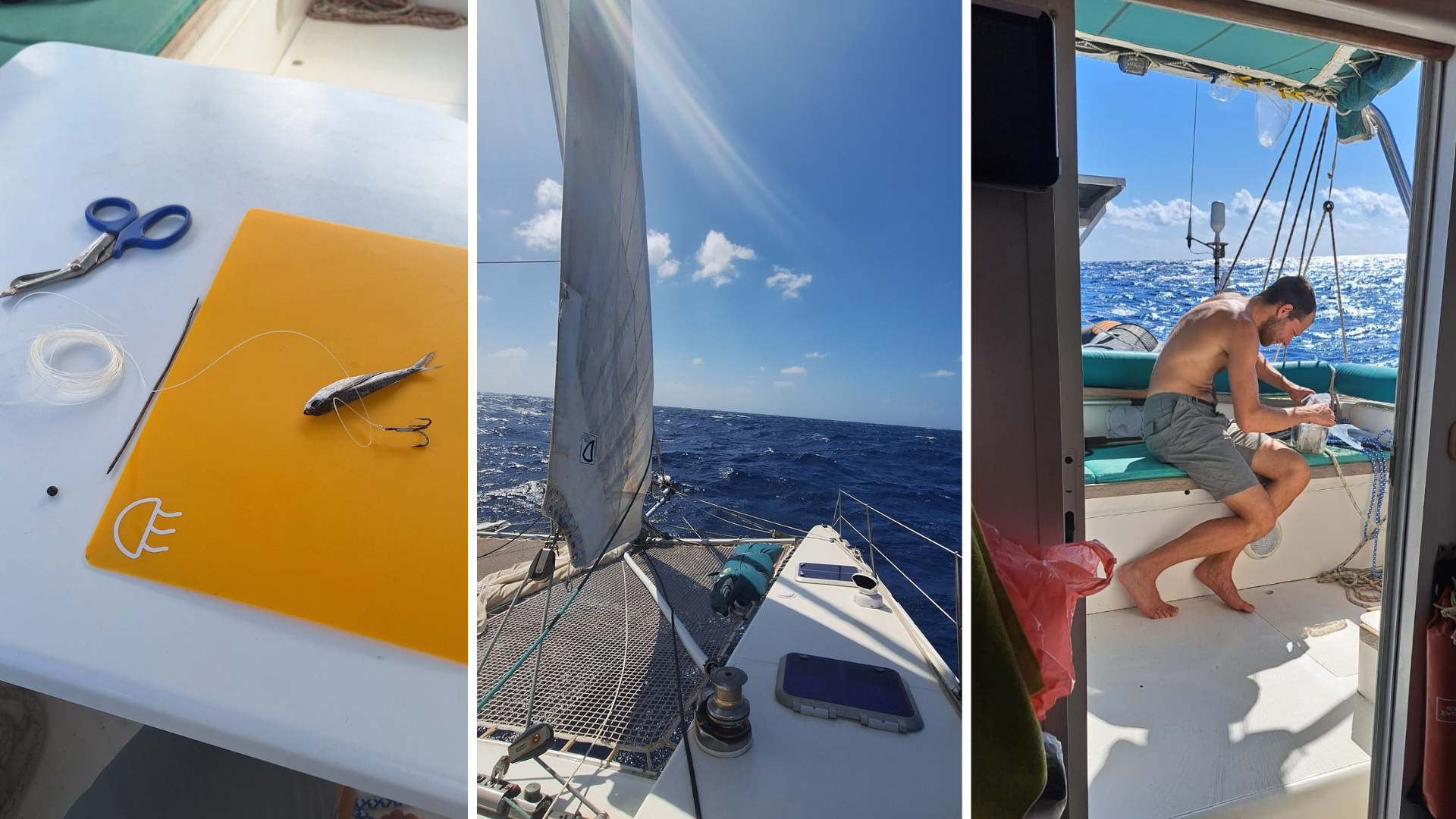
Il mio turno di guardia è finito da poco e sfrutto il mio tempo libero per creare una nuova esca. Mi sto cimentando nella pesca a traino, finora con risultati negativi: zero pesci e tre esche perse. Gli unici che abbiamo mangiato per ora sono i pesci volanti che ogni tanto trovo al mattino, stecchiti sul ponte. Di notte, attirati dalle luci di posizione, saltano a bordo del catamarano. Uso come esca i più piccoli, perdendoli miseramente ogni volta, ma non demordo. Mentre cerco un nuovo modo di assemblare lenza, amo e piombi sul pesce, ripenso a ciò che è successo nelle ultime due settimane, da quando sono entrato a far parte dell’equipaggio di Laia.
(Per gli impazienti che vogliono sapere subito com’è attraversare l’Oceano: andate più sotto a ‘4 dicembre’)
13 novembre
Sono sul molo della marina di Mindelo, un po’ teso: sto aspettando Noël, il capitano di un catamarano con cui potrei fare la traversata. Siamo rimasti d’accordo che mi unirò alla ciurma per qualche giorno; faremo un po’ di vela insieme tra le isole di Cabo Verde, e se la vibe è buona, farò la traversata con loro. Saremo solo in tre, per cui dovrò imparare molto. In questo momento mi assalgono i dubbi: sarò in grado di imparare tutto il necessario? Piacerò a loro? E soprattutto, mi piaceranno? Mi sentirò al sicuro con loro? Le traversate in barca a vela sono come dei lunghi viaggi in camper, con la differenza che non puoi mai scendere: meglio scegliere i compagni giusti.
Mentre sono perso nelle mie paranoie, un signore mi fa cenno con la mano: è Noël. Carichiamo il mio zaino sul dinghy (gommone a motore) e facciamo due chiacchiere mentre zigzaghiamo tra le barche per raggiungere il catamarano, ancorato fuori dalla marina. Noël sembra un signore cordiale e gentile, proprio come me lo ero immaginato durante le nostre chiamate. Arrivati sul catamarano, faccio conoscenza con Tessa, l’unico altro membro dell’equipaggio. Nonostante la loro cordialità, mi sento scannerizzato e squadrato, ma d’altronde, come potrei lamentarmi? Anche io li sto squadrando per bene.
Il sole sta tramontando, è quasi ora di cena: Noël mi chiede se preferisco iniziare il tour del catamarano dall’interno o dall’esterno. Sembra una domanda-test, e quando rispondo “Fuori, perché c’è ancora luce e perché è la parte con cui voglio entrare meglio in confidenza”, Noël dice: “Ottima scelta”. Beh sì, credo proprio che fosse un test.
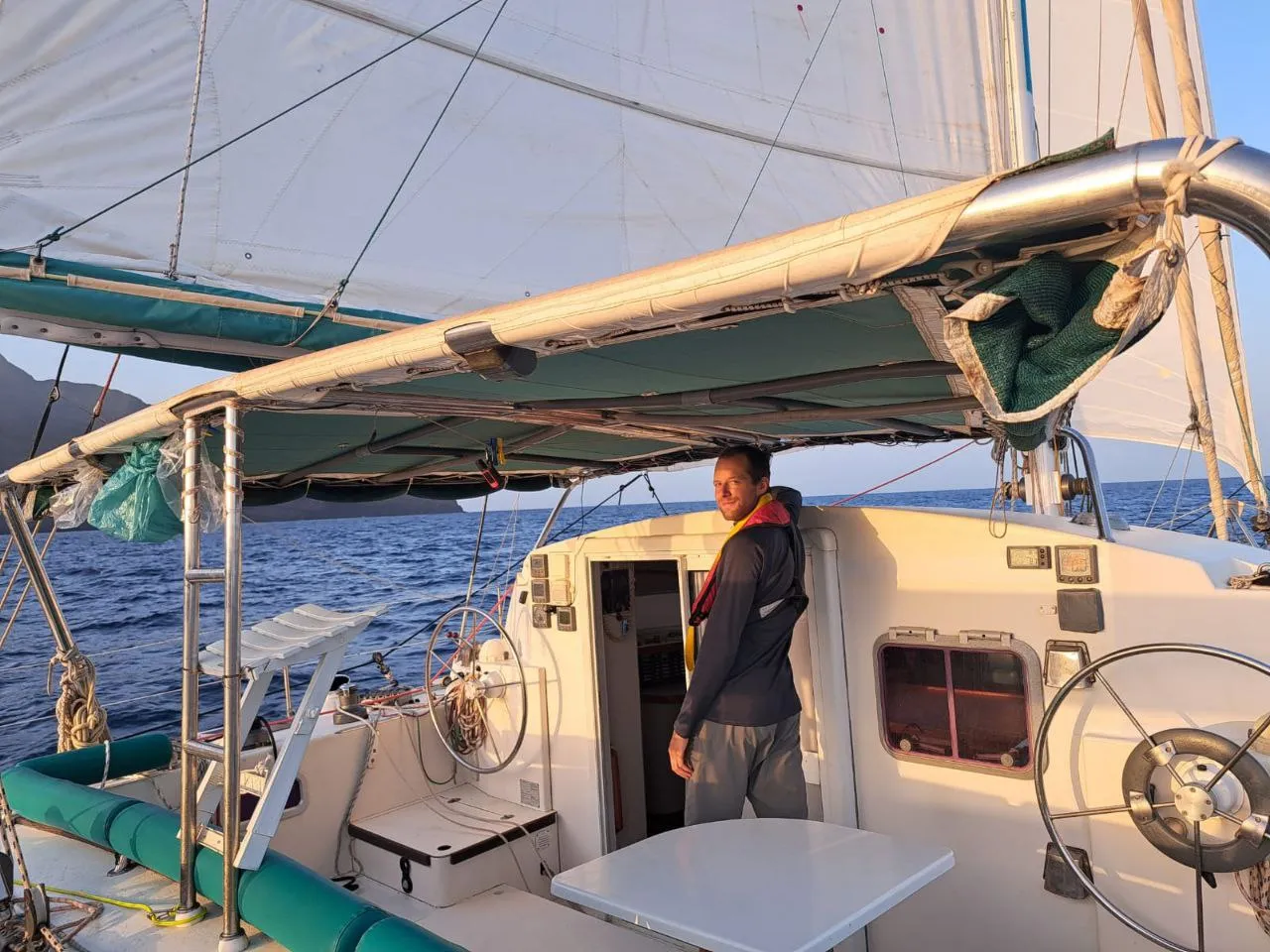
E così faccio conoscenza con la protagonista indiscussa della ciurma: il catamarano Laia. Un Outremer 45, Laia è un catamarano progettato per le regate offshore. Questo significa principalmente due cose: la prima è che non è spaziosa come le barche di simili dimensioni; la seconda è che ha più vele delle altre barche, quindi più cime, più assetti possibili e molte più cose da imparare. Che gaso! Uno dei miei compiti principali sarà quello di assistere Noël durante il cambio delle vele finché eventualmente potrò farlo da solo.
Noël mi presenta Laia, le sue cime, le vele, l’ancora, l’albero maestro, il meccanismo di issaggio del dinghy, i motori e molto altro. Sono tante informazioni, impossibili da ricordare tutte sul momento: imparerò con la pratica. Noël vive stabilmente su Laia e con il passare degli anni ha modificato l’interno della barca per essere il più confortevole possibile. Laia è inoltre splendidamente autosufficiente, con pannelli solari e dissalatore. Non avremo mai bisogno di un porto o di una marina: ancoreremo sempre fuori, in rada. È un po’ come vivere in camper e non aver mai bisogno dei campeggi.
Mentre Noël mi sovraccarica di informazioni, Tessa prepara la cena: è lei il cuoco ufficiale. Dopo aver mangiato, facciamo qualcosa che diventerà parte della nostra routine serale: decidere insieme che cosa fare il giorno dopo. Ognuno ha le proprie preferenze, ma sia Noël che Tessa sono molto aperti a nuove proposte e flessibili. Io apprezzo molto questo momento di decisione collettiva: è la prima delle numerose green flag che noterò nei giorni successivi.
Noël e Tessa hanno navigato una giornata intera per raggiungermi a Mindelo. Il piano è quindi di fermarci un paio di giorni qui per riposare, per poi tornare indietro verso est, per esplorare Santa Luzia: isola disabitata, riserva naturale al 100%. Mi incarico di contattare le capitanerie per ottenere i permessi necessari per sbarcare sull’isola, realizzando in fretta la difficoltà dell’impresa. Le mie email e messaggi vengono rimbalzati tra vari uffici e ufficiali, ricevendo ogni volta informazioni contrastanti: “sì, potete sbarcare senza problemi” / “no, è assolutamente proibito” / “potete ancorare se pagate 50000 escudos”, eccetera.
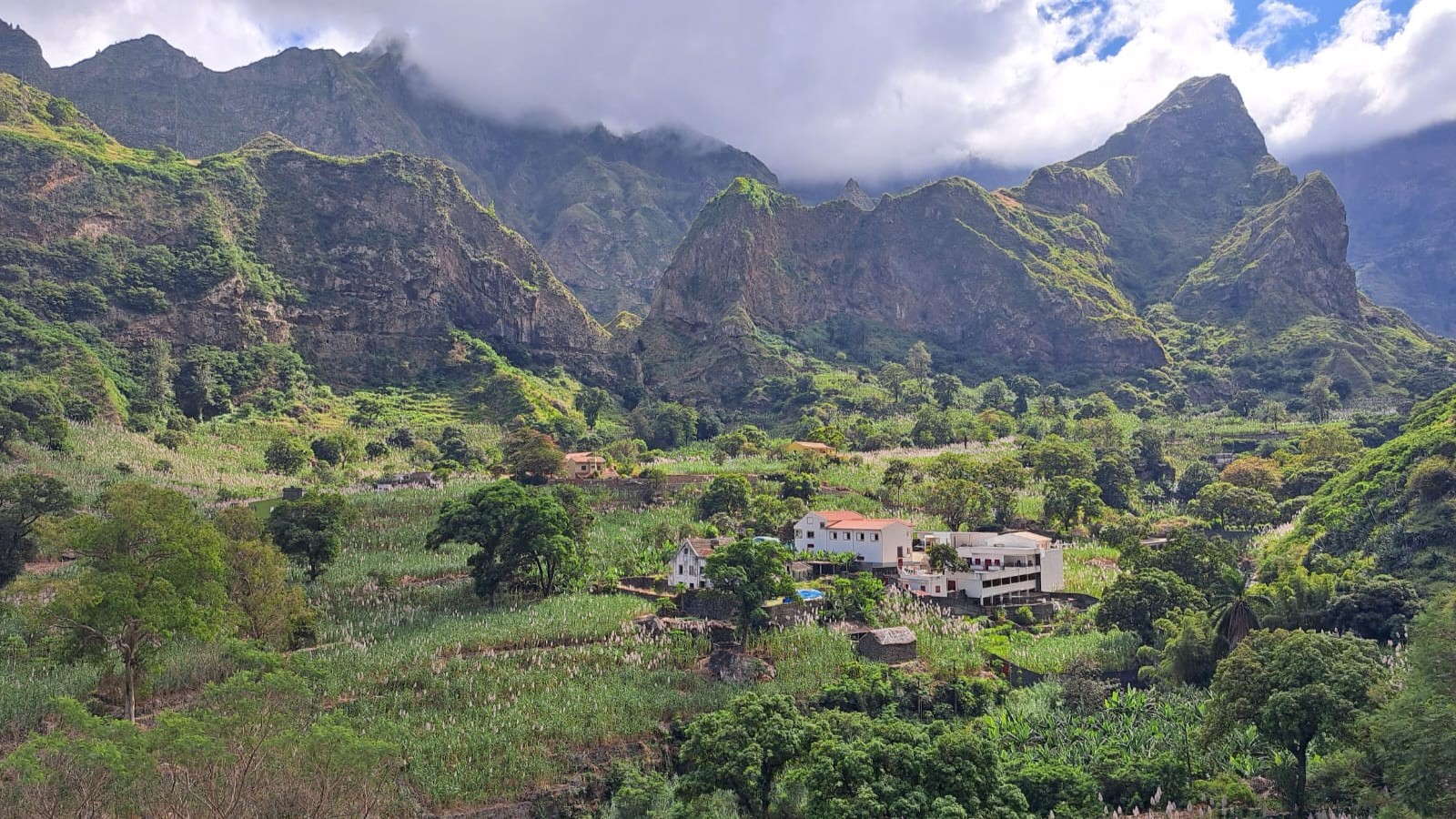
Decidiamo quindi di cancellare Santa Luzia dall’itinerario e fare rotta verso… Santo Antão! L’isola in cui sono stato pochi giorni prima, metà verde lussureggiante stile Avatar e metà deserta come un film di Sergio Leone, che ho lasciato con le lacrime agli occhi e con la promessa di tornare un giorno. Certo non mi immaginavo che sarebbe arrivato così presto.
Partiamo la mattina del terzo giorno. Santo Antão è molto vicina, a circa un’ora di navigazione. Durante il breve tragitto, Noël ci fa fare qualche esercitazione di “man overboard” (uomo in mare). Bisogna reagire velocemente quando qualcuno cade in mare: bastano pochi secondi per perdere di vista la testa di una persona tra i flutti. Per massimizzare le probabilità di successo, una persona deve continuamente puntare il braccio verso l’uomo in mare; intanto, un’altra persona prende il timone, fa la manovra di heave to per posizionare la barca controvento fino a fermarla, regola le vele per tornare indietro e recuperare il malcapitato, posizionando la barca tra l’uomo in mare e il vento, lanciandogli un giubbotto salvagente assicurato alla barca. È un esercizio molto utile, mi fa prendere confidenza con Laia; chissà se ne avremo mai bisogno sul serio.
Ancoriamo davanti al primo paesino di Santo Antão, Porto Novo, e passiamo i due giorni successivi a goderci l’isola. Io e Tessa ci perdiamo tra le valli verdissime, mentre Noël si gira l’isola in motocicletta. Nel tardo pomeriggio ci ritroviamo tutti su Laia dopo le nostre esplorazioni. Approfitto delle ultime ore di luce per le mie sessioni di apnea. È un posto ideale: siamo ancorati su un fondale profondo dieci metri vicino a qualche roccia, ricca di vita marina.
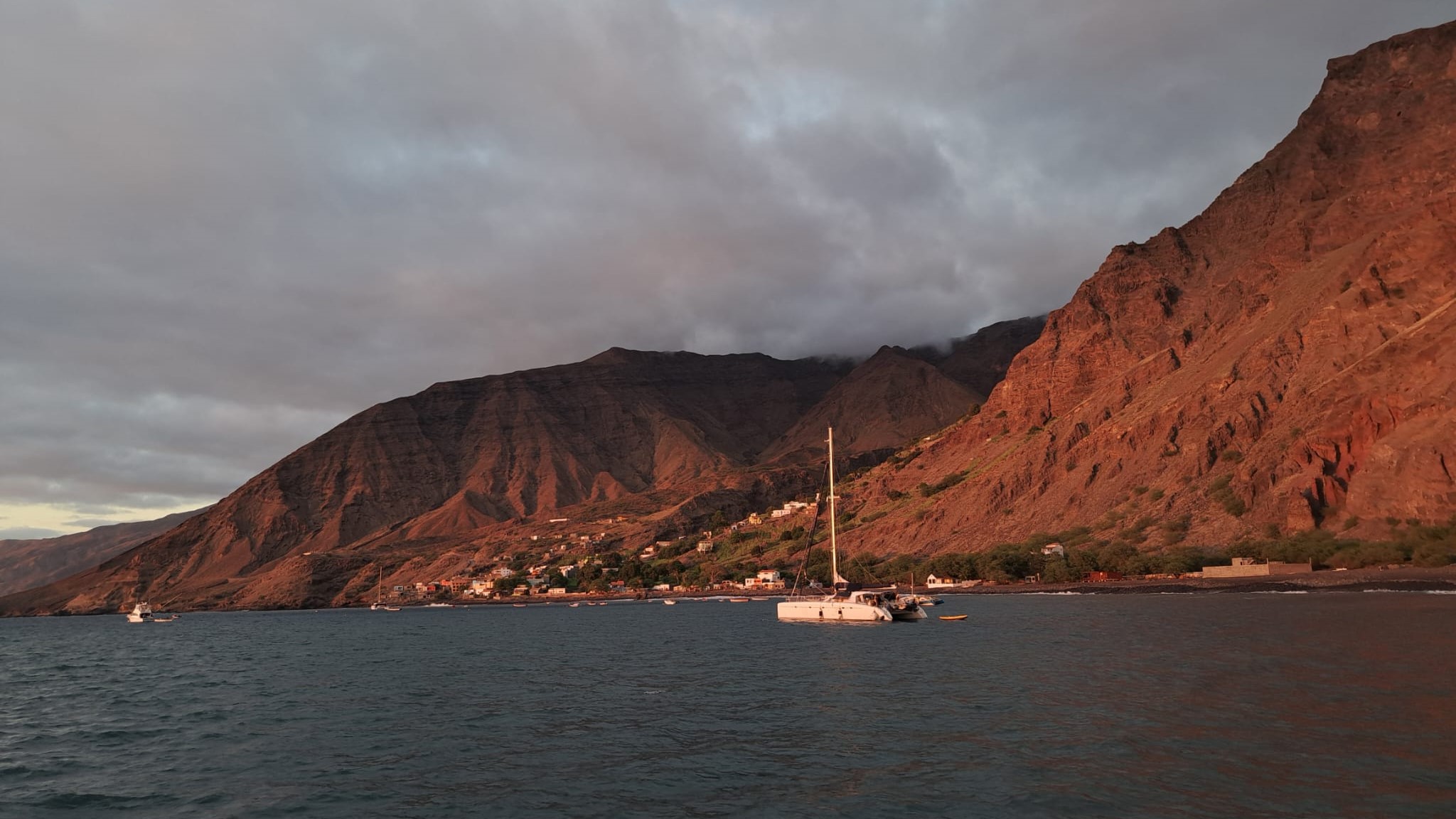
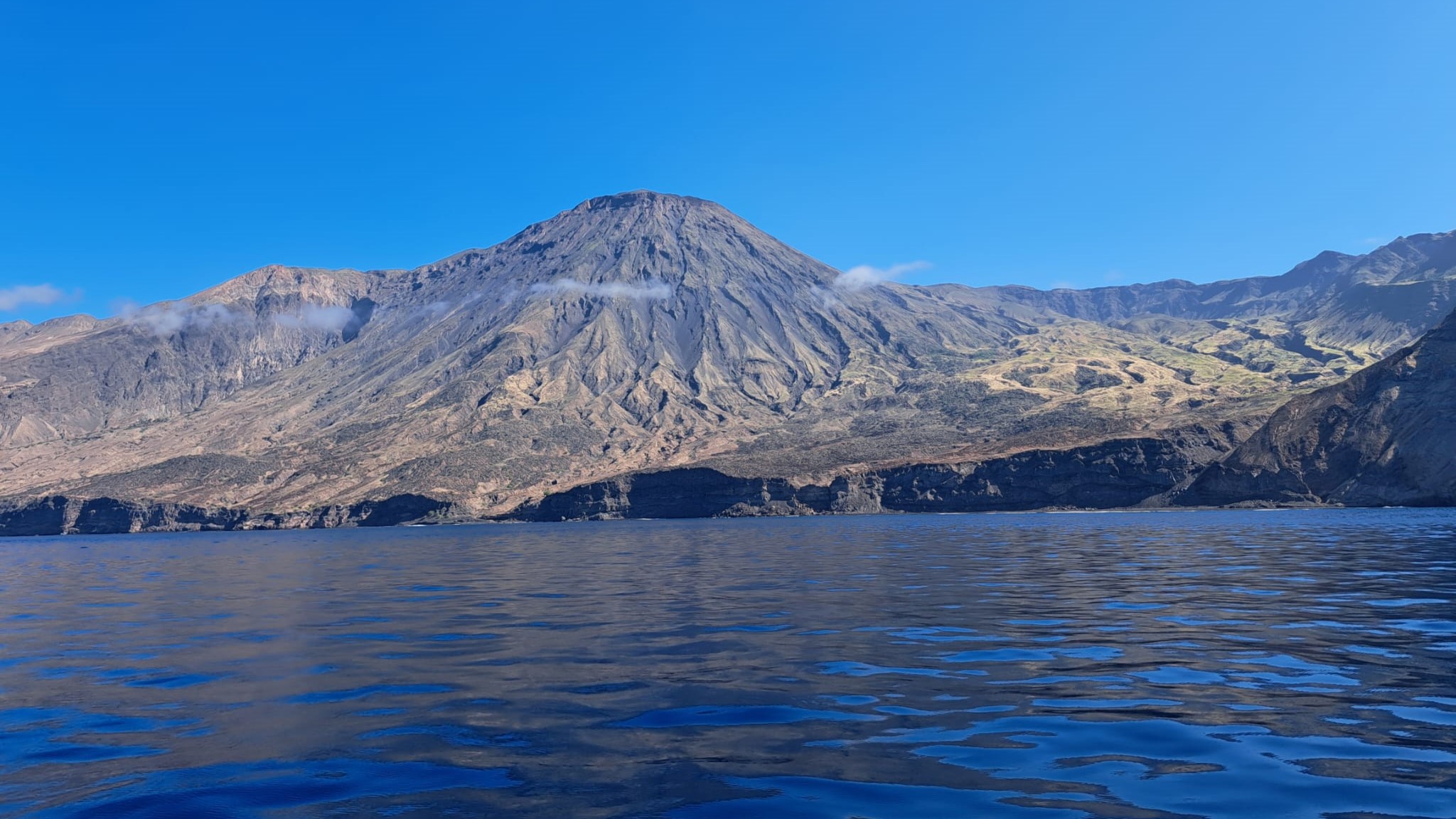
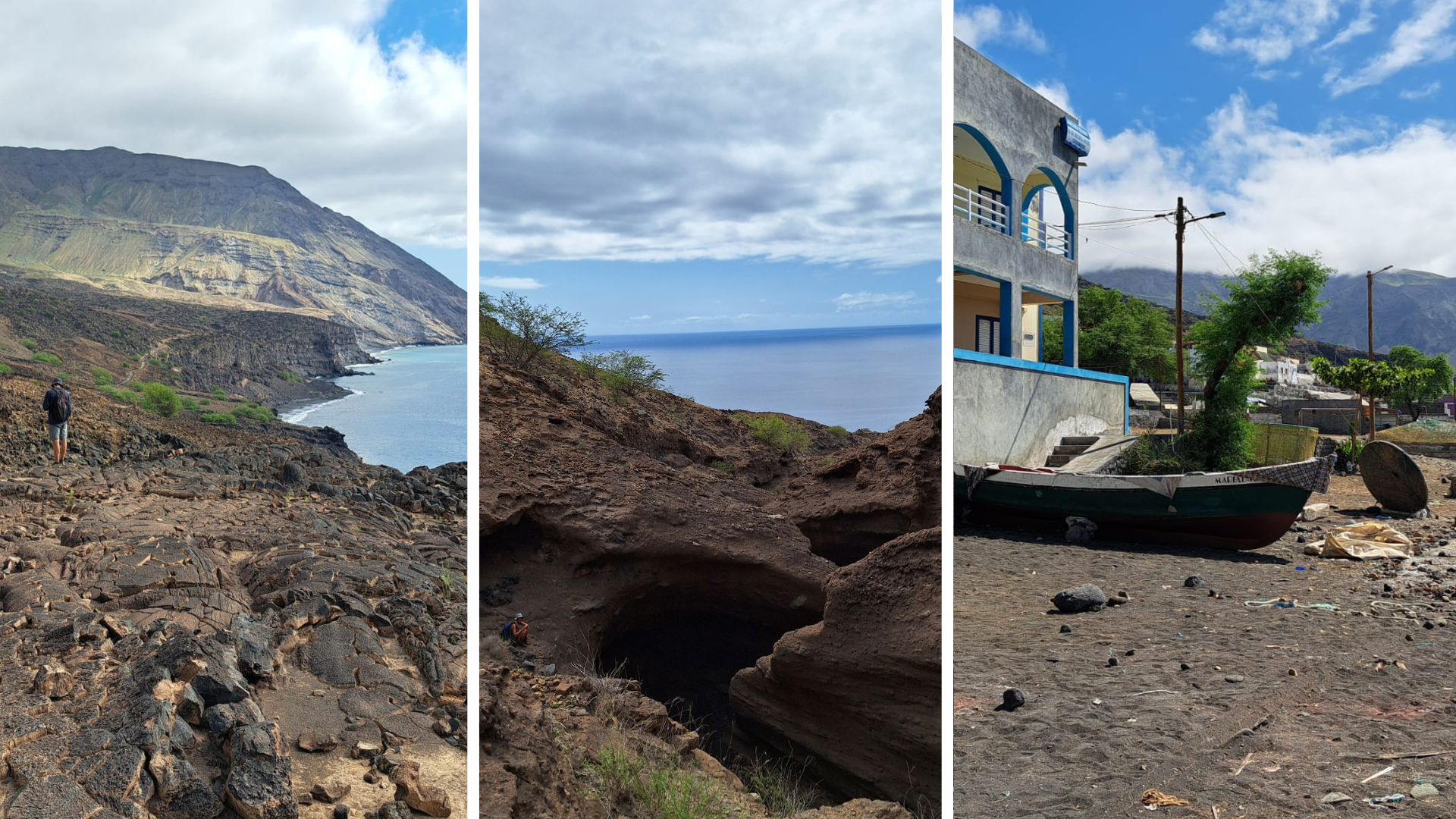
Nei giorni seguenti navighiamo lungo la parte desertica di Santo Antão, in cerca di un buon posto per ancorare. Non è semplice: anche se siamo sottovento all’isola, le onde rimangono troppo forti. Giungiamo all’ultimo villaggio dell’isola: Tarrafal de Monte Trigo. È un minuscolo insediamento di pescatori raggiungibile solo tramite tre ore di cammino, o in barca. Il paesaggio è dominato da montagne brulle, antichi vulcani spenti: sulle pendici dei monti, la roccia vulcanica ha mantenuto la forma delle colate laviche. Io e Tessa passiamo un intero pomeriggio esplorando un’enorme formazione di canyon, un labirinto senza fine. Tarrafal de Monte Trigo è l’insediamento più a ovest di Santo Antão, che è l’isola più a ovest dell’arcipelago di Cabo Verde: oltre, solo l’Oceano Atlantico, fino al continente americano. Sembra di stare alla fine del mondo.
Questi giorni di avventure capoverdiane sono perfetti per conoscere meglio i miei due compagni di viaggio.
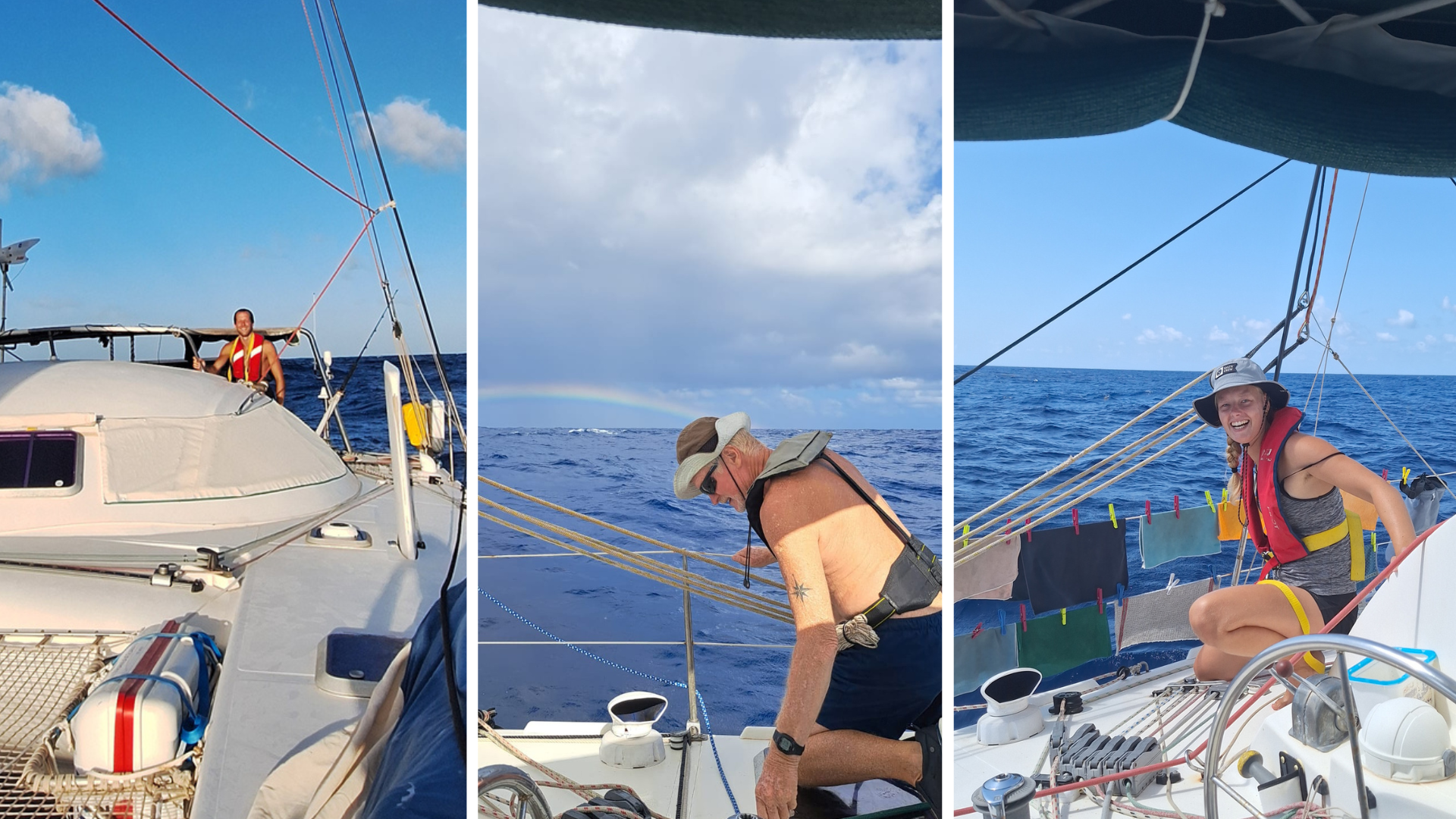
Tessa è una ragazza olandese, di cinque anni più giovane di me. Conosce bene Noël e Laia, con cui ha già fatto la traversata Azzorre – Regno Unito, più altre gite nel Mediterraneo. Per studio, ha passato gli ultimi sei mesi alle isole Svalbard, letteralmente al Polo Nord. Io sono curiosissimo e le faccio mille domande sulle Svalbard: Tessa è innamorata dell’Artico e le brillano gli occhi quando mi racconta la sua vita lì. Motoslitte, grotte di ghiaccio, feste techno a -40 gradi, notte perenne, sole di mezzanotte, trecentomila strati di vestiti. Le storie che preferisco sono quelle sugli orsi polari: i più grandi carnivori terrestri del pianeta, tra i pochi animali che cacciano l’uomo come una preda. La vita alle Svalbard passa per forza attraverso la convivenza con questi giganti bianchi.
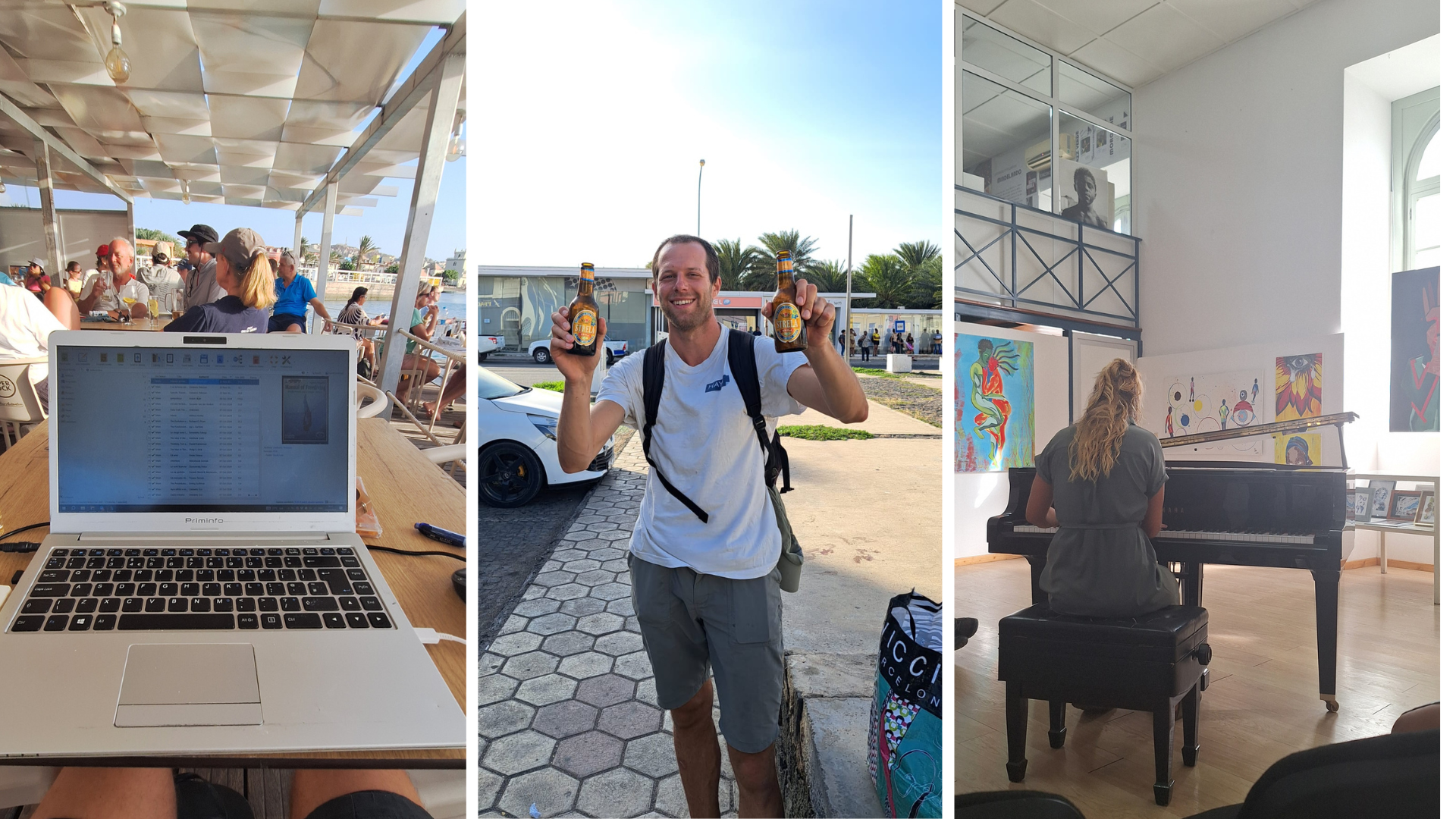
Scopro che Tessa è anche un’eccellente musicista quando inizia a suonare il pianoforte a coda nel centro culturale di Mindelo e viene invitata dal direttore a fare un concertino prima di partire per la traversata. Grazie al suo orecchio assoluto, ripete ogni jingle, motivetto, fischio e suono che sentiamo con incredibile precisione.
Tessa mi insegna moltissime cose su Laia e sul mondo della vela. È la mia maestra ufficiale di nodi: iniziamo con slipknot, bowline, cleat knot. I nodi sono il mio tallone d’Achille, me li dimentico in continuazione, specialmente quando sono sotto pressione. Ma Tessa è una maestra esigente: me li fa fare anche ad occhi chiusi, letteralmente. Non si sa mai quando dovrai farne uno: potrebbe scaricarsi la tua luce frontale di notte o potresti finire sott’acqua quando il catamarano si capovolge e un nodo potrebbe salvarti la vita.
Noël è francese, pensionato da poco. Spirito libero, nella sua vita ha vissuto in diverse città sparse per il globo. Da alcuni anni, Laia è la sua casa. È una grande opportunità poter imparare vela con lui. È un maestro paziente, preciso, non si risparmia nelle spiegazioni quando lo bombardo di domande. Quando gli chiedo come funziona l’ancoraggio, prende carta e penna e per un’ora mi spiega tutto lo scibile umano sulle ancore, i gradi dell’angolo di ancoraggio, i tipi di fondali, ecc. Non perde il controllo neanche quando gli chiedo per la trentesima volta qual è la drizza del gennaker. Gli faccio perdere la pazienza solo quando non mi vengono i nodi in alcuni momenti cruciali. È un esperto lupo di mare ed è un piacere ascoltare le sue avventure (di vela e non) in giro per il mondo.
Malgrado mi sembri filare tutto liscio, mi rimane un po’ di tensione in sottofondo perché sono ancora in “periodo di prova”. Non mi hanno ancora dato l’ok ufficiale per fare la traversata insieme. Da parte mia sarebbe un grande sì: mi sento sicuro con loro. Sono affidabili, competenti e a livello personale non ci sono attriti. Attendo il loro verdetto, che arriva un pomeriggio in modo inaspettato. Mentre chiacchiero con Tessa su un sentiero nella valle di Paul, tra il verde lussureggiante e le piante di banano, dico: “In caso facessi la traversata con voi, chissà come sarebbe stare senza dopamina da internet per qualche settimana”, al che Tessa mi dice: “Come sarebbe NON vuoi fare la traversata con noi??? Ormai sei dei nostri”. Al che capisco che il mio periodo di prova era già terminato con successo, si erano semplicemente dimenticati di dirmelo.
Dopo esserci goduti Santo Antão, torniamo a Mindelo per prepararci alla traversata. Navighiamo controvento e Noël ci insegna a fare tacking, cioè a fare continui zigzag portando il vento prima a destra e poi a sinistra della prua, per poter procedere controvento. Ma prima di arrivare a Mindelo, manca ancora un ultimo step: lo scafo di Laia, specialmente la parte perennemente sommersa, si riempie periodicamente di alghe e barnacles, che aumentano la resistenza all’acqua e rallentano notevolmente il catamarano. Ogni tanto bisogna dare una bella pulita, e questo compito è stato assegnato a me.
Io adoro stare in acqua: pulire la parte sommersa dello scafo mi gasa perché è un ottimo modo di praticare apnea. Non avrei voluto aspettare l’ultimo momento, ma il giorno in cui mi ero prefissato di farlo avvistammo un grande squalo dietro Laia a un paio di km da dove avremmo ancorato. Una volta fermi, provai comunque a immergermi, ma la visibilità era di appena un paio di metri ed ero troppo suggestionato. Probabilmente lo squalo se n’era già andato chissà dove — e chissà quanti altri ce n’erano senza che li avessimo visti — ma non me la sentii di passare ore in quell’acqua torbida con la costante sensazione di essere osservato.
Ci fermiamo quindi a pochi chilometri da Mindelo in una baia deserta così che io possa pulire lo scafo, siccome alla marina di Mindelo nuoterei tra la merda scaricata da tutte le barche dell’area. Scopriamo che nella baia vivono diverse tartarughe che vengono a farmi visita mentre sto pulendo – o meglio, quando le vedo mi lancio all’inseguimento. Scopro che non siamo gli unici passeggeri di Laia: diversi tipi di granchi e gamberetti vivono nei suoi angoli più remoti.
Dopo aver finito, Tessa mi racconta che la ragazza che puliva lo scafo prima di me, dopo una sessione di pulizia, aveva iniziato a sentire un prurito insistente dentro un orecchio. Ebbene sì, uno dei granchietti di Laia si era trasferito nel suo condotto uditivo.
E così ancoriamo di nuovo a Mindelo: l’ultimo giorno prima della partenza. La mattina guardiamo la partenza dell’ARC+, il rally transatlantico. Decine di barche a vela partono, come noi, con destinazione Caraibi: Noël vuole dar loro un giorno di vantaggio e poi superarne qualcuna. Il resto della giornata lo passiamo tra provviste, ultime birrette e chiamate prima di essere senza alcol e connessione per due o tre settimane. Tessa ci incastra anche un concertino di piano al centro culturale di Mindelo e lascia tutti a bocca aperta.
All’alba del giorno dopo, il 23 novembre, leviamo l’ancora e partiamo. La nostra destinazione è l’isola più a est dei Caraibi: Barbados.
4 dicembre
Ed eccoci qui, quasi alla fine della traversata. Se tutto va bene, dovremmo arrivare a Barbados domani.
Com’è attraversare l’Atlantico?
È un po’ routinario, un po’ no. Mi spiego meglio.
I miei turni di guardia sono gli stessi ogni giorno: dalle 6 alle 9 e dalle 21 a mezzanotte. Siccome siamo solo in tre, quasi sempre almeno uno di noi sta dormendo. Ci troviamo tutti insieme solo per il pranzo e la cena. Siccome stiamo attraversando quattro fusi orari, ogni qualche giorno resettiamo gli orologi; ma l’ora di cena rimane sempre al tramonto, quando il sole tocca l’orizzonte, qualsiasi sia il fuso orario.
Ogni mattina mi sveglio alle 5:50, il tempo di lavarmi la faccia e fare un’enorme cagata mattutina (unica della giornata), per poi dare il cambio a Tessa, che mi accoglie sempre con un bel “Buongiorno principessaaa” (in italiano) prima di farmi il briefing routinario: limiti di angolo e velocità del vento che l’attuale assetto delle vele può sostenere, cosa ci aspettiamo nelle prossime ore, barche in possibile rotta di collisione, tempeste nelle vicinanze.
Mentre monitoro la situazione mi preparo la colazione: uova con chorizo, pane, formaggio fresco e marmellata di guayaba comprati dalle signore di Cabo Verde, una banana, frutta secca, yogurt con cereali. Non riesco mai a prepararmi la colazione senza interruzioni: il vento fa il pazzerello e devo spesso modificare la rotta per rientrare nei parametri stabiliti. Man mano che procediamo durante la traversata, la scorta di cibo fresco scarseggia e la mia colazione ne risente: pane a cassetta, formaggio stagionato plasticoso, marmellata industriale, niente frutta fresca.
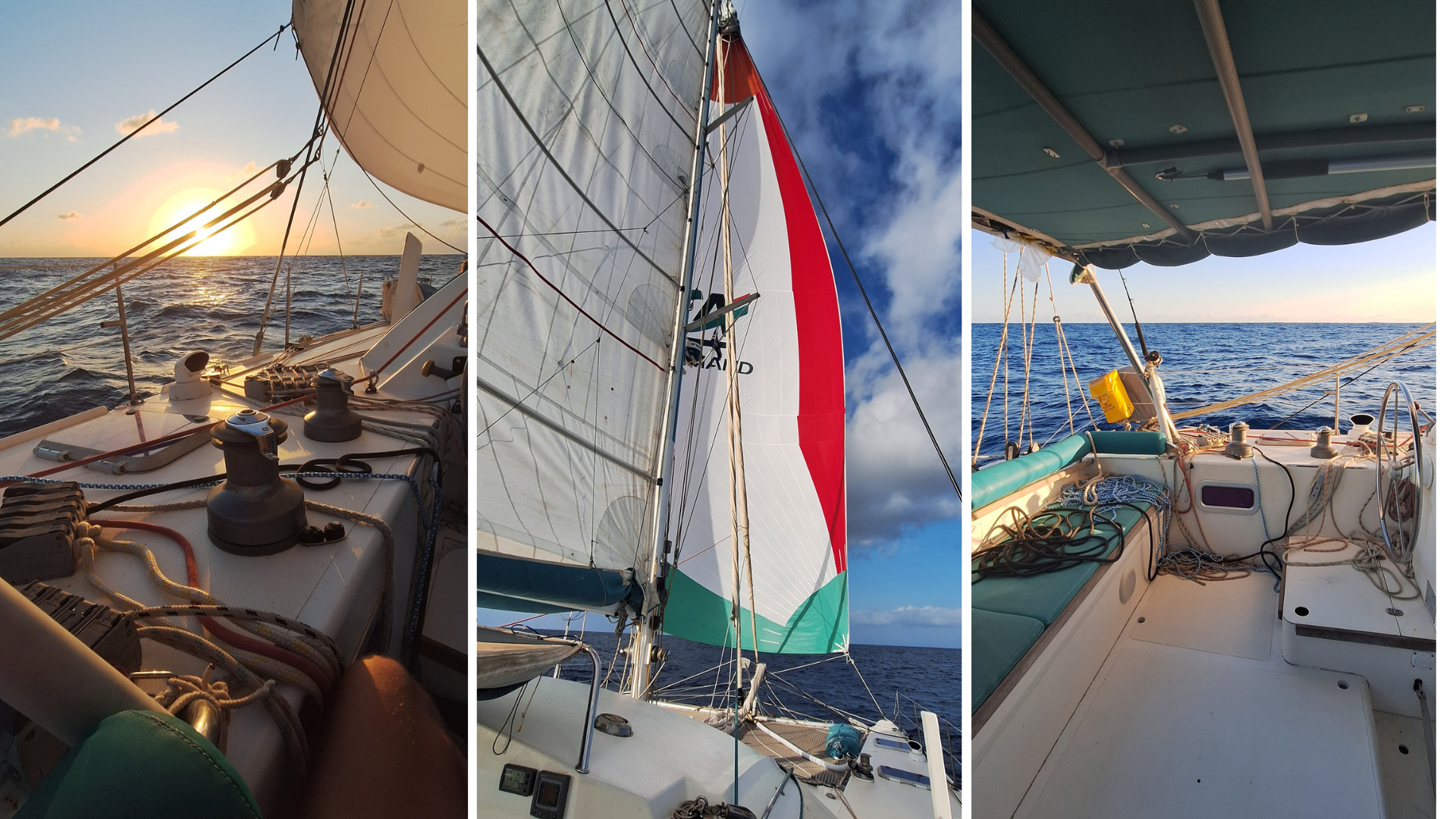
Noël si sveglia verso la fine del mio turno e decidiamo quali vele mettere in base alle previsioni meteo — che scarichiamo con un’antenna satellitare due volte al giorno. Mainsail, jib, genoa, gennaker, spinnaker; a Laia piace pavoneggiarsi con una vasta scelta di vele. Ogni mattino ci mettiamo almeno un’ora a issare le vele, che comunque cambieremo sovente durante la giornata in base ai capricci del vento.
Passo il resto della giornata con la calma che solo essere completamente circondati dall’oceano può dare. Leggo alcuni libri che rimando da troppo tempo, tra cui il manuale d’apnea di Umberto Pellizzari. Mi esercito a secco (fuori dall’acqua) in vista di arrivare a Barbados: Laia è la perfetta piattaforma per fare apnea, un tuffo e sei già sul fondale profondo, specialmente se convinci Noël ad ancorare su un bel fondale di 15 metri. A bordo ci sono anche diversi libri sulla vela e sulle isole dei Caraibi, e così la mia curiosità ha abbastanza materiale per un paio di mesi.
Dopo il tramonto, qualsiasi sia il fuso orario in cui ci troviamo, è ora di cena. Seguono subito le mie due ore di pisolino e mi sveglio in tempo per il turno di guardia delle 21. Di nuovo briefing con Tessa, che poi se ne va a dormire. Passo le mie tre ore di guardia notturna aggiustando la rotta e sperando che il vento non faccia scherzi; ogni tanto arriva qualche breve folata e prego di non sentire il rumore di una vela squarciata (chissà che rumore fa) per il troppo vento. Di solito me ne sto fuori a guardare le stelle. Ogni notte imparo due o tre costellazioni: parto sempre da Cassiopea e da lì inizio a riconoscere le altre: Perseo, Ariete, Cefeo, Toro, Orione…
Su Laia i protocolli di sicurezza vengono rispettati scrupolosamente — e non è cosa comune. Di notte, durante la guardia solitaria, sempre il giubbotto salvagente addosso e sempre attaccati alla lifeline. Ogni tanto guardo le onde nere e penso a come sarebbe cadere in acqua e vedere il catamarano che si allontana rapidamente, sparendo dalla vista in pochi secondi. Rimanere solo, nel buio, con solo le stelle sopra di me, aspettando una lenta fine. Questi pensieri mi fanno controllare che la lifeline sia ben attaccata — you never know.
A mezzanotte sveglio Noël, lo aggiorno sulla situazione e cambiamo le vele se ce n’è bisogno. Poi me ne vado a dormire. Alle 5:50 mi sveglio… e il gioco ricomincia.
Il mio corpo si adatta molto bene a questa routine e in un paio di giorni ho già preso il ritmo.
Sembrerebbe un viaggio quasi noioso, ma la parte routinaria è ben controbilanciata: tutti i giorni succede qualcosa di imprevisto. E comunque non mi farebbe schifo annoiarmi un po’…
Gli squall sono tra i più grandi pericoli: tempeste locali, troppo piccole per comparire sulle previsioni meteo, si muovono a gran velocità. Essere sorpresi da uno squall senza ammainare le vele in tempo vuol dire che il vento strapperà le vele nel migliore dei casi, o ribalterà il catamarano nel peggiore. La buona notizia è che un catamarano non può affondare, neppure ribaltato o con una falla, a meno che non succeda qualcosa di disastroso come un incendio a bordo. La cattiva notizia è che avere un catamarano ribaltato in mezzo all’oceano vuol dire assicurare la zattera salvavita al catamarano e aspettare i soccorsi: questo se riesci a sopravvivere al ribaltamento, trovare la zattera salvavita, i dispositivi di comunicazione d’emergenza e le scorte di cibo e acqua per sopravvivere a sufficienza. Insomma, diciamo che buttiamo sempre un occhio nel caso si veda uno squall all’orizzonte. Più ci avviciniamo ai Caraibi, più il rischio aumenta.
Ma siamo fortunati: in tutta la traversata ne arriva soltanto uno, e neanche troppo forte. Io e Tessa ne approfittiamo per farci l’unica vera e propria doccia (sotto la pioggia) della traversata. Il dissalatore che “produce” acqua per lavarci consuma parecchia energia, e spesso i pannelli solari sono parzialmente coperti dalle vele. Dobbiamo fare molta attenzione a razionare l’acqua. Ci laviamo con bacinella e spugna: una doccia completa è un lusso che non ci possiamo permettere. Per cui stavolta grazie mille, mister squall!
Il vento è capriccioso: spesso cambia durante la giornata e ci costringe a cambiare le vele. Ma è un’operazione che non mi annoia mai. Più lo faccio, più entro in confidenza con Laia. Verso fine traversata Noël non deve (quasi) più darmi indicazioni quando bisogna decidere quale vela issare in base al vento. Imparare è una sensazione fantastica.
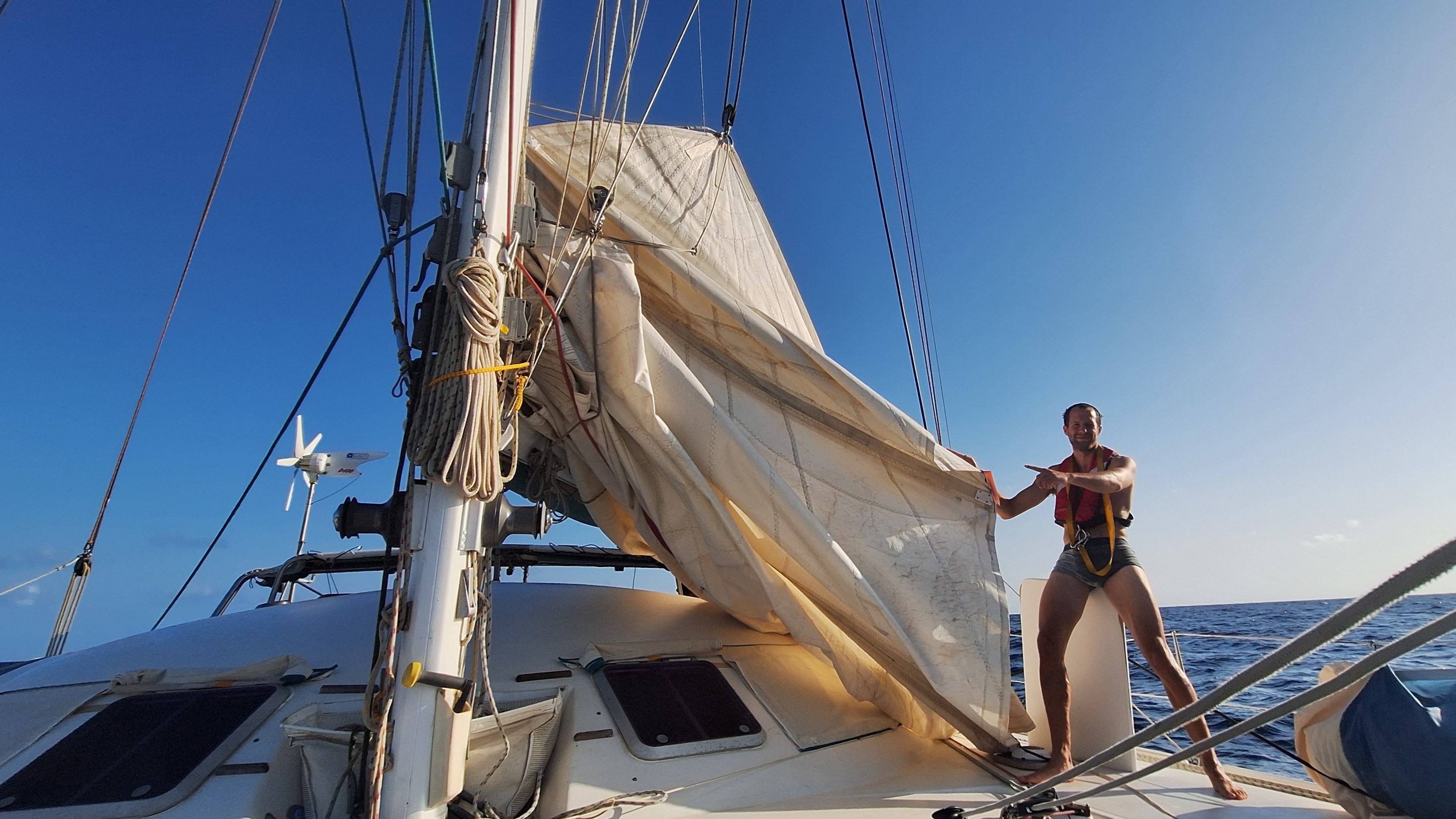
Uno dei primi giorni di traversata mi sveglio dal mio sonnellino pomeridiano, salgo in cabina e la trovo sottosopra, tutti i materassi dei divani alla cazzo. Cosa succede? Esco, vedo Tessa e Noël gridare qualcosa tra di loro (il vento è forte e se non gridi non ti senti). Poi vedo: la randa (vela maestra) è caduta ed è mezza accartocciata sul tetto della cabina. Qualche cima ha ceduto, ma nulla di troppo grave. Dopo le foto ricordo accanto alla randa afflosciata, la issiamo di nuovo: potremo tenerla solo fino al secondo reef. Caleremo leggermente di velocità, ma pazienza.
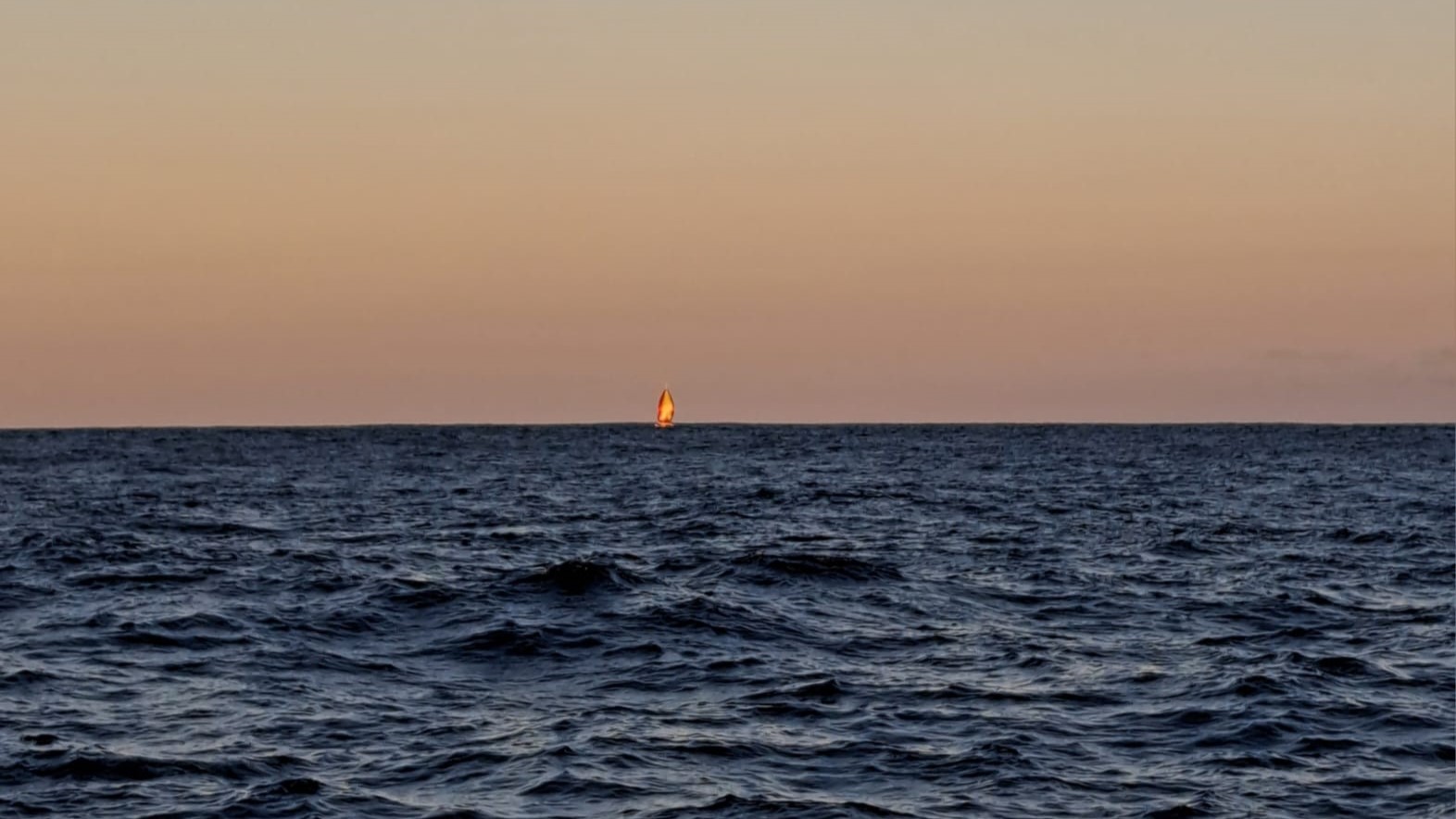
In realtà Laia rimane velocissima: già il secondo giorno vediamo sull’AIS diverse barche che avevamo visto partire per l’ARC+. Le abbiamo già raggiunte. Noël sprizza gioia quando superiamo qualche barca, anche se non lo dà a vedere. Per “superare” non bisogna immaginare un sorpasso da MotoGP; di solito siamo lontani diverse miglia e le barche sono appena visibili sulla linea dell’orizzonte. A parte un giorno in cui per puro caso ci troviamo molto vicini a una barca: Noël si anima, prende il timone e passiamo loro accanto stando a qualche decina di metri di distanza per urlarci qualche saluto prima di allontanarci. È strano “parlare” con qualcuno nel mezzo dell’oceano.
Laia è felice e mostra tutto il suo carattere da catamarano da corsa. Nei giorni migliori, con un ottimo vento e surfando grandi onde, superiamo i 19 nodi. Metto le cose in prospettiva quando penso che sul Bikini gioivamo per 9 nodi. Laia è una stallona purosangue.
Ma i nostri più grandi nemici della traversata sono gli spinnaker. Lo spinnaker è una vela che si issa con vento portante, cioè quando il vento arriva dal traverso largo fino alla poppa: in parole povere, quando il vento arriva da dietro. Noël ne ha ben due, di cui uno comprato recentemente di seconda mano e mai provato. E quale miglior momento per provarlo se non in mezzo all’Atlantico? D’altronde dobbiamo far passare i nostri pomeriggi in qualche maniera.
In una giornata con il vento in poppa issiamo lo spinnaker “nuovo”: è leggermente piccolo per Laia ma porta bene. Dopo qualche ora però si sente uno strano rumore: lo spinnaker si spezza in due, la parte superiore sventola in alto come una grande bandiera e la parte inferiore finisce in acqua sotto Laia. Passiamo diverse ore bestemmiando, cercando di ammainare il pezzo di spinnaker rimasto in alto e tirando fuori dall’acqua quello finito in mare. Per miracolo non si incastra nell’elica del catamarano: lo issiamo sul ponte e lo stendiamo ad asciugare, per poi riporlo in stiva il giorno successivo.
Ma è con l’altro spinnaker che partono le vere bestemmie. Il signorino si mostra inizialmente ben portato, lavora bene, è ben pieno di vento e stabile. Dopo qualche ora mostra la sua anima ribelle e inizia ad avvitarsi su se stesso. È molto, molto peggio dello spinnaker spezzato in due. Una vela attorcigliata può comunque riempirsi di vento e generare forte trazione. Cercare di trattenerla mentre la si ammaina è estremamente difficile, perché sotto carico sviluppa una forza improvvisa e potente: è come cercare di fermare un toro imbestialito afferrandolo per le zampe.
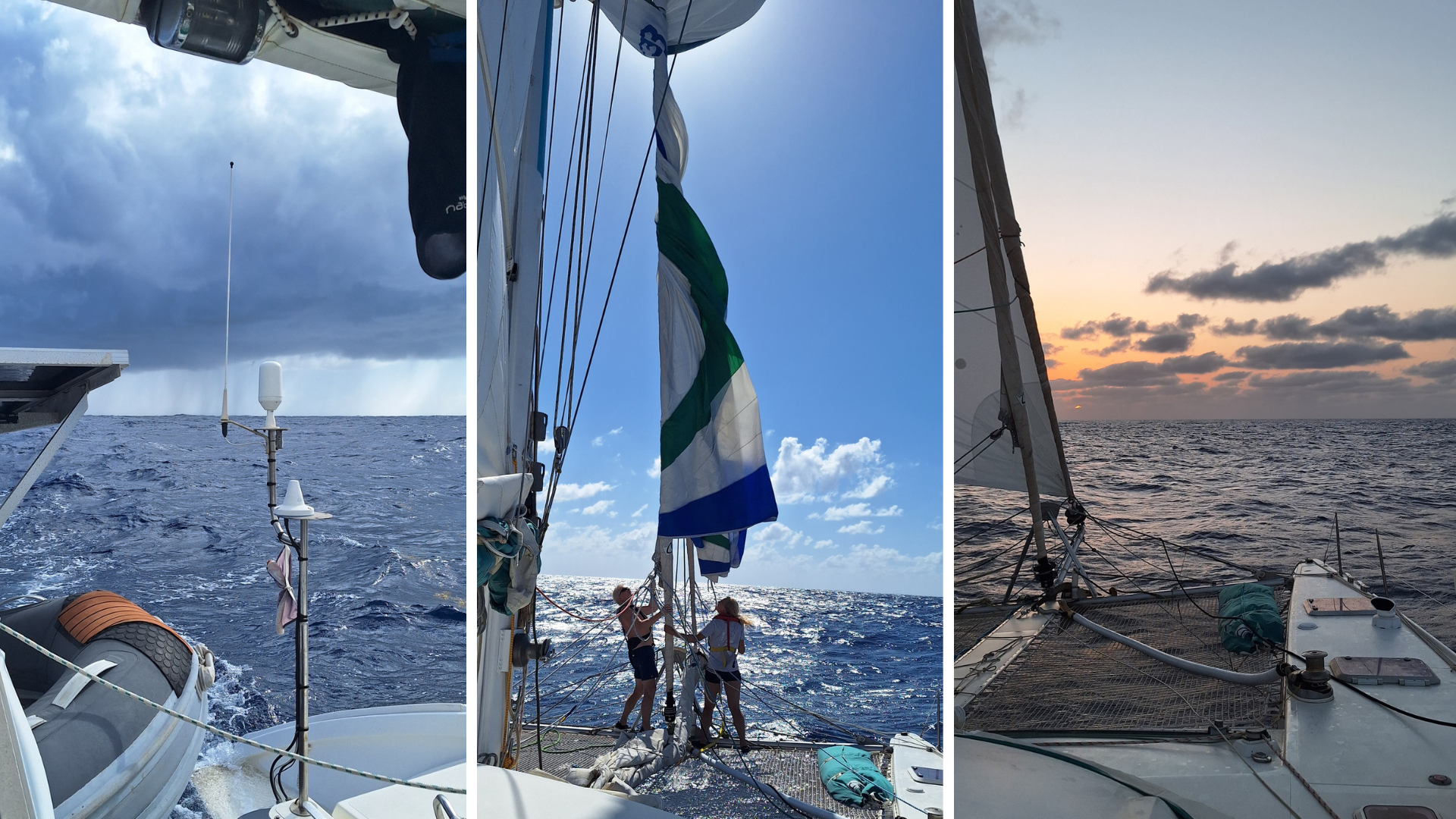
Escogitiamo diversi metodi e dopo tante ore di fatica riusciamo a tirarla parzialmente giù. Man mano che la stendiamo sul ponte la leghiamo. Ma la parte ancora libera è un cavallo imbizzarrito: tira, strattona, minaccia di gonfiarsi e schizzare in alto. A un certo punto la mia lifeline rimane sopra lo spinnaker e la vela si gonfia di botto, strattonando la lifeline e facendomi fare un salto di un metro: cado quasi in mare. Continuiamo a bestemmiare e lottare contro lo spinnaker: prima che arrivi il tramonto, il grande verme attorcigliato giace sul ponte, legato per bene. Abbiamo vinto.
Stare senza connessione internet per così tanti giorni mi fa capire davvero quanto ne sia dipendente. L’astinenza di dopamina da social media è una bestia orribile. Dopo giorni in mare, ogni tanto mi sorprendo a prendere il telefono e aprire Instagram senza pensarci, guardando gli stessi post che ho nella home da quando siamo partiti. Fa ridere (non tanto), ma fa anche riflettere.
Possiamo comunque comunicare con il mondo esterno: Laia è dotata di un’antenna satellitare Iridium, la stessa del mio Garmin portatile. La usiamo per scaricare le previsioni meteo, una volta al mattino e una alla sera. Spesso le guardo con Noël: modelli diversi danno previsioni diverse, e scegliamo come muoverci e dove andare in base alla direzione e intensità del vento predetta dai modelli. Possiamo anche inviare brevi messaggi (massimo 256 caratteri) ai nostri cari per confermare di essere vivi e condividere la nostra posizione GPS in tempo reale. Le chiamate hanno costi astronomici, ma a metà traversata Noël ci concede il lusso di due minuti di chiamata a testa per sentire la voce di una persona cara.
5 dicembre
Mi sveglio come sempre alle 5:50. C’è qualcosa di diverso… un odore strano, che non sentiamo da 12 giorni: odore di terra — non è un modo di dire, si sente per davvero. Il sole sta sorgendo: sull’orizzonte vedo delle luci fioche. È Barbados. Siamo arrivati.
We are literally in the middle of the Atlantic, about halfway through the crossing. We’ve left 2,000 km of ocean behind us and have another 2,000 to go before reaching the Caribbean. The catamaran Laia is surfing enormous blue waves — the bluest blue I’ve ever seen. Every now and then some curious seagulls pay us a visit: they glide around the mast, but are suspicious enough not to stop and rest. I wonder what they’re doing out here in the middle of nowhere; they’re probably wondering the same thing about us.
My watch just ended and I’m using my free time to make a new lure. I’ve been trying my hand at trolling fishing, so far with zero results: no fish and three lost lures. The only ones we’ve eaten so far are the flying fish I occasionally find in the morning, stiff on the deck. Drawn by the navigation lights at night, they leap aboard the catamaran. I use the smaller ones as bait, losing them miserably every time, but I refuse to give up. While figuring out a new way to rig line, hook and sinker onto the fish, I think back on everything that’s happened over the last two weeks, since I joined Laia’s crew.
(For those who can’t wait and want to know immediately what it’s like to cross the ocean, skip ahead to ‘4 December’.)
November 13
I’m on the dock at the Mindelo marina, a little tense: I’m waiting for Noël, the captain of a catamaran I might be crossing the Atlantic with. We agreed that I’d join the crew for a few days — we’d sail together between the Cape Verde islands, and if the vibe was right, I’d do the crossing with them. There will only be three of us, so I’ll have a lot to learn. Right now the doubts are piling up: will I be able to learn everything I need to? Will they like me? And above all, will I like them? Will I feel safe with them? Ocean crossings on a sailboat are like long road trips in a campervan, except you can never get out — better choose the right companions.
While I’m lost in my anxieties, a man waves at me: it’s Noël. We load my backpack onto the dinghy and chat as we zigzag between the boats to reach the catamaran, anchored outside the marina. Noël seems like a warm and friendly man, exactly as I’d imagined him from our calls. Once aboard, I meet Tessa, the only other crew member. Despite their friendliness, I feel like I’m being scanned and sized up — though how could I complain? I’m sizing them up too.
The sun is setting, it’s almost dinner time: Noël asks whether I’d prefer to start the tour of the catamaran from the inside or the outside. It feels like a test question, and when I answer “Outside, because there’s still light and because it’s the part I want to get most familiar with,” Noël says: “Excellent choice.” Well yes, I’m pretty sure it was a test.
And so I’m introduced to the undisputed star of the crew: the catamaran Laia. An Outremer 45, Laia is a catamaran designed for offshore racing. This mainly means two things: first, she’s not as spacious as boats of similar size; second, she has more sails than other boats — meaning more lines, more possible configurations, and a lot more to learn. How exciting! One of my main tasks will be to assist Noël during sail changes until I can eventually do it on my own.
Noël introduces me to Laia — her lines, sails, anchor, mast, the dinghy hoisting mechanism, the engines and much more. It’s too much information to remember all at once; I’ll learn through practice. Noël lives permanently on Laia and over the years has modified the interior to be as comfortable as possible. Laia is also beautifully self-sufficient, with solar panels and a watermaker. We’ll never need a port or marina: we’ll always anchor offshore, in open water. It’s a bit like living in a campervan and never needing a campsite.
While Noël overwhelms me with information, Tessa prepares dinner — she’s the official cook. After eating, we do something that will become part of our evening routine: decide together what to do the following day. Everyone has their own preferences, but both Noël and Tessa are very open to new suggestions and flexible. I really appreciate this moment of collective decision-making: it’s the first of many green flags I’ll notice in the days that follow.
Noël and Tessa sailed a full day to reach me in Mindelo. The plan is therefore to stay here a couple of days to rest, then head back east to explore Santa Luzia: an uninhabited island, 100% nature reserve. I take it upon myself to contact the harbour authorities to get the necessary permits to go ashore, quickly realising what a challenge that turns out to be. My emails and messages get bounced between various offices and officials, each time receiving contradictory information: “yes, you can land without any problem” / “no, it’s absolutely forbidden” / “you can anchor if you pay 50,000 escudos,” and so on.
We decide to drop Santa Luzia from the itinerary and instead set course for… Santo Antão! The island I’d visited just a few days earlier — half lush green like Avatar, half desert like a Sergio Leone film — which I had left in tears, promising myself I’d return one day. I certainly didn’t imagine it would be this soon.
We leave on the morning of the third day. Santo Antão is very close, about an hour’s sail away. During the short crossing, Noël has us run some “man overboard” drills. You need to react fast when someone falls in the water: it only takes a few seconds to lose sight of a person’s head in the waves. To maximise the chances of success, one person must continuously point their arm toward the person in the water; meanwhile, another takes the helm, performs the heave-to manoeuvre to bring the boat into the wind until it stops, adjusts the sails to turn back and recover the unfortunate soul, positioning the boat between them and the wind, and throws a lifejacket tied to the boat. It’s a very useful exercise — it helps me get comfortable with Laia. Who knows if we’ll ever need it for real.
We anchor off the first village on Santo Antão, Porto Novo, and spend the next two days enjoying the island. Tessa and I get lost in the lush green valleys, while Noël tours the island on a motorbike. Late in the afternoon we all gather back on Laia after our explorations. I take advantage of the last hours of daylight for my freediving sessions. It’s an ideal spot: we’re anchored over a ten-metre-deep seabed near some rocks, teeming with marine life.
In the following days we sail along the desert side of Santo Antão, looking for a good anchorage. It’s not easy: even though we’re on the island’s lee side, the waves remain too strong. We reach the last village on the island: Tarrafal de Monte Trigo. It’s a tiny fishing settlement accessible only by three hours on foot, or by boat. The landscape is dominated by bare mountains — ancient extinct volcanoes — whose slopes have preserved the shapes of old lava flows. Tessa and I spend an entire afternoon exploring a vast canyon formation, an endless labyrinth. Tarrafal de Monte Trigo is the westernmost settlement on Santo Antão, which is the westernmost island in the Cape Verde archipelago: beyond it, only the Atlantic Ocean stretches all the way to the American continent. It feels like the edge of the world.
These days of Cape Verdean adventure are perfect for getting to know my two travel companions better.
Tessa is a Dutch girl, five years younger than me. She knows Noël and Laia well, having already completed the Azores–United Kingdom crossing with them, plus other trips in the Mediterranean. For her studies, she spent the last six months in Svalbard — literally at the North Pole. I’m incredibly curious and pepper her with questions: Tessa is in love with the Arctic and her eyes light up when she tells me about her life there. Snowmobiles, ice caves, techno parties at -40 degrees, endless night, midnight sun, three hundred thousand layers of clothing. My favourite stories are about the polar bears: the largest land carnivores on the planet, among the few animals that hunt humans as prey. Life in Svalbard inevitably revolves around coexisting with these white giants.
I discover that Tessa is also an exceptional musician when she starts playing the grand piano at the Mindelo cultural centre and is invited by the director to give a little concert before departing for the crossing. Thanks to her perfect pitch, she can reproduce every jingle, tune, whistle and sound she hears with incredible precision.
Tessa teaches me an enormous amount about Laia and about sailing. She’s my official knots teacher: we start with a slip knot, a bowline, a cleat hitch. Knots are my Achilles’ heel — I keep forgetting them, especially under pressure. But Tessa is a demanding teacher: she makes me tie them with my eyes closed, literally. You never know when you’ll need to tie one: your headlamp might die at night, or you might end up underwater when the catamaran capsizes, and a knot could save your life.
Noël is French, recently retired. A free spirit, he has lived in various cities scattered around the globe. For the past few years, Laia has been his home. It’s a great privilege to learn sailing from him. He’s a patient, precise teacher and never holds back on explanations when I bombard him with questions. When I ask him how anchoring works, he gets out paper and pen and spends an hour explaining everything there is to know about anchors — angle of attack, seabed types, and so on. He doesn’t lose his cool even when I ask for the thirtieth time which halyard the gennaker is on. He only loses patience when I can’t tie knots at crucial moments. He’s an experienced old sea dog and it’s a pleasure to listen to his adventures — sailing and otherwise — from around the world.
Although everything seems to be going smoothly, I still feel a low-level tension because I’m still in my “trial period.” They haven’t officially given me the green light for the crossing yet. For my part it would be a resounding yes: I feel safe with them. They’re reliable, competent, and there’s no friction on a personal level. I wait for their verdict, which arrives one afternoon in the most unexpected way. While chatting with Tessa on a path through the valley of Paul, surrounded by lush greenery and banana plants, I say: “If I were to do the crossing with you, I wonder what it’d be like to be without internet dopamine for a few weeks” — to which Tessa replies: “What do you mean IF you do the crossing with us??? You’re one of us now.” And that’s when I realise my trial period had already ended successfully; they’d simply forgotten to tell me.
After enjoying Santo Antão, we head back to Mindelo to prepare for the crossing. We sail upwind and Noël teaches us tacking — making continuous zigzags, bringing the wind first to the right and then to the left of the bow, in order to make headway against the wind. But before reaching Mindelo, there’s one more step: Laia’s hull, especially the part that’s permanently submerged, periodically gets covered in algae and barnacles, which increase water resistance and significantly slow the catamaran down. Every so often it needs a good clean, and that job has been assigned to me.
I love being in the water: cleaning the underwater hull excites me because it’s a great way to practice freediving. I wouldn’t have wanted to leave it to the last minute, but the day I’d planned to do it we spotted a large shark behind Laia a couple of kilometres from where we were going to anchor. Once we’d stopped, I tried to get in anyway, but the visibility was only a couple of metres and I was too unsettled. The shark had probably gone off somewhere else by then — and who knows how many others there were that we hadn’t seen — but I couldn’t bring myself to spend hours in that murky water with the constant feeling of being watched.
So we stop a few kilometres from Mindelo in a deserted bay so I can clean the hull, since at the Mindelo marina I’d be swimming through the waste pumped out by every boat in the area. We discover that several turtles live in the bay and come to visit me while I’m cleaning — or rather, the moment I spot them I go chasing after them. I also discover that we’re not the only passengers on Laia: various crabs and shrimp live in her most remote corners.
When I finish, Tessa tells me about the girl who used to clean the hull before me: after one session, she started feeling a persistent itch inside her ear. Sure enough, one of Laia’s little crabs had moved into her ear canal.
And so we anchor in Mindelo once again: the last day before departure. In the morning we watch the start of the ARC+, the transatlantic rally. Dozens of sailboats set off, like us, bound for the Caribbean: Noël wants to give them a day’s head start and then overtake a few. We spend the rest of the day on provisions, last beers and phone calls before being without alcohol or connectivity for two or three weeks. Tessa even squeezes in a piano concert at the Mindelo cultural centre and leaves everyone speechless.
At dawn the following day, November 23rd, we weigh anchor and depart. Our destination is the easternmost island of the Caribbean: Barbados.
December 4
And here we are, almost at the end of the crossing. If all goes well, we should arrive in Barbados tomorrow.
What is it like to cross the Atlantic?
It’s partly routine, partly anything but. Let me explain.
My watches are the same every day: 6 to 9 AM and 9 PM to midnight. Since there are only three of us, at least one person is almost always sleeping. We’re all together only for lunch and dinner. Since we’re crossing four time zones, every few days we reset the clocks; but dinner time always stays at sunset, when the sun touches the horizon, whatever the time zone.
Every morning I wake up at 5:50, just enough time to wash my face and have my one substantial morning visit to the toilet, before relieving Tessa, who always greets me with a cheerful “Buongiorno principessaaa” (Good morning, princess — in Italian) before giving me the routine briefing: wind angle and speed limits that the current sail configuration can handle, what to expect in the coming hours, boats on a possible collision course, nearby storms.
While monitoring the situation I make breakfast: eggs with chorizo, bread, fresh cheese and guayaba jam bought from the ladies of Cape Verde, a banana, dried fruit, yogurt with granola. I never manage to make breakfast without interruptions: the wind plays tricks and I often have to adjust course to stay within the established parameters. As the crossing progresses, the fresh food supply dwindles and my breakfast suffers: sliced bread, plasticky aged cheese, shop-bought jam, no fresh fruit.
Noël wakes up toward the end of my watch and we decide which sails to use based on the weather forecast — which we download via satellite antenna twice a day. Mainsail, jib, genoa, gennaker, spinnaker; Laia loves to show off her wide wardrobe of sails. Every morning it takes us at least an hour to hoist the sails, which we’ll change frequently throughout the day depending on the wind’s whims.
I spend the rest of the day with the kind of calm that only being completely surrounded by ocean can give. I read some books I’ve been putting off for too long, including Umberto Pellizzari’s freediving manual. I practise dry (out of the water) in preparation for arriving in Barbados: Laia is the perfect platform for freediving — one dive and you’re already on the seabed, especially if you can convince Noël to anchor over a nice 15-metre bottom. On board there are also several books about sailing and the Caribbean islands, giving my curiosity enough material for a couple of months.
After sunset, whatever the time zone we’re in, it’s dinner time. My two-hour nap follows immediately, and I wake up in time for the 9 PM watch. Another briefing with Tessa, who then goes to sleep. I spend my three hours of night watch adjusting course and hoping the wind doesn’t play games; every now and then a brief gust rolls through and I pray I won’t hear the sound of a sail tearing (I wonder what that sounds like) from too much wind. Usually I just stay outside looking at the stars. Every night I learn two or three constellations: I always start from Cassiopeia and work outward from there — Perseus, Aries, Cepheus, Taurus, Orion…
On Laia, safety protocols are followed scrupulously — and that’s not something you can take for granted. At night, during solo watch, the lifejacket is always on and you’re always clipped to the lifeline. Every now and then I look at the black waves and think about what it would be like to fall in and watch the catamaran rapidly pulling away, disappearing from sight in seconds. Being left alone, in the dark, with only the stars above me, waiting for a slow end. These thoughts make me double-check that the lifeline is properly clipped — you never know.
At midnight I wake Noël, update him on the situation, and we change the sails if needed. Then I go to sleep. At 5:50 I wake up… and it starts all over again.
My body adapts very well to this routine and within a couple of days I’ve already found my rhythm.
It might seem like a nearly boring voyage, but the routine side is well balanced by the unexpected: something unplanned happens every single day. And honestly, a little boredom wouldn’t kill me…
Squalls are among the greatest dangers: local storms, too small to show up in weather forecasts, moving at high speed. Being caught by a squall without taking down the sails in time means the wind will tear them in the best case, or capsize the catamaran in the worst. The good news is that a catamaran cannot sink, even if capsized or holed, unless something catastrophic happens like a fire on board. The bad news is that having a capsized catamaran in the middle of the ocean means lashing the life raft to it and waiting for rescue — and that’s assuming you survive the capsize, find the life raft, the emergency communication devices and enough food and water to hold out long enough. In short, let’s just say we always keep an eye out for squalls on the horizon. The closer we get to the Caribbean, the greater the risk.
But we’re lucky: in the whole crossing only one arrives, and not even a particularly strong one. Tessa and I take the opportunity to have the only real shower (under the rain) of the entire crossing. The watermaker that produces our washing water consumes a lot of energy, and the solar panels are often partially shaded by the sails. We have to be very careful about rationing water. We wash with a basin and sponge: a proper shower is a luxury we can’t afford. So thank you very much, mister squall!
The wind is fickle: it often shifts throughout the day and forces us to change sails. But it’s an operation that never bores me. The more I do it, the more comfortable I get with Laia. By the end of the crossing Noël barely needs to give me instructions when deciding which sail to hoist based on the wind. Learning is a fantastic feeling.
On one of the first days of the crossing I wake up from my afternoon nap, climb into the cabin and find it in chaos — all the sofa cushions thrown everywhere. What’s going on? I go outside and see Tessa and Noël shouting something to each other (the wind is strong and if you don’t shout you can’t be heard). Then I see it: the mainsail has come down and is half-crumpled on the cabin roof. One of the lines had given way, but nothing too serious. After the commemorative photos next to the collapsed mainsail, we hoist it again: we’ll only be able to carry it to the second reef. We’ll lose a little speed, but no matter.
In fact Laia remains incredibly fast: on the second day we already spot on the AIS several boats we’d seen leave for the ARC+. We’ve already caught them. Noël beams with joy whenever we pass a boat, even if he doesn’t show it. “Overtaking” shouldn’t be imagined as a MotoGP-style manoeuvre; usually we’re several miles apart and the other boats are barely visible on the horizon. Except for one day when we happen to find ourselves very close to another boat: Noël comes alive, takes the helm and we pass alongside them at just a few dozen metres, shouting greetings back and forth before sailing away. It’s strange to “talk” to someone in the middle of the ocean.
Laia is in her element and shows her full racing catamaran character. On the best days, with excellent wind and surfing big waves, we exceed 19 knots. I put things in perspective when I think back to how thrilled we were on Bikini to hit 9 knots. Laia is a thoroughbred.
But our biggest headaches during the crossing are the spinnakers. A spinnaker is a sail hoisted with a following wind — that is, when the wind comes from the broad beam to the stern: in plain terms, when the wind comes from behind. Noël has two, one of which was recently bought second-hand and never tried. And what better moment to try it than in the middle of the Atlantic? After all, we need something to keep our afternoons occupied.
On a day with a downwind breeze we hoist the “new” spinnaker: it’s slightly small for Laia but pulls nicely. After a few hours, though, a strange noise: the spinnaker splits in two — the upper half flapping in the air like a giant flag, the lower half ending up in the water under Laia. We spend several hours cursing, trying to lower the piece still flying overhead and hauling out the piece that went in the water. By some miracle it doesn’t get tangled in the propeller: we hoist it onto the deck and spread it out to dry, then stow it the following day.
But it’s with the other spinnaker that the real cursing begins. It initially seems well-behaved — pulling nicely, full of wind and stable. After a few hours it reveals its rebellious nature and starts twisting around itself. This is far, far worse than a split spinnaker. A twisted sail can still fill with wind and generate enormous pull. Trying to hold it while bringing it down is extremely difficult, because under load it produces sudden, powerful force: it’s like trying to stop a raging bull by grabbing its legs.
We devise several methods and after many exhausting hours manage to partially bring it down. As we spread it across the deck we tie it section by section. But the part still loose is a bucking horse: it pulls, jerks, threatens to billow and shoot back up. At one point my lifeline gets caught over the spinnaker and the sail suddenly fills with air, yanking the lifeline and launching me a metre into the air: I nearly go overboard. We keep cursing and wrestling with the spinnaker: before sunset, the great twisted worm lies on the deck, tied down tight. We’ve won.
Being without internet for so many days makes me truly realise how dependent on it I am. The withdrawal from social media dopamine is a vicious beast. After days at sea, I sometimes catch myself picking up my phone and opening Instagram without thinking, staring at the same posts that have been in my feed since we left. It’s funny (sort of), but it also makes you think.
We can still communicate with the outside world: Laia is equipped with an Iridium satellite antenna, the same as my portable Garmin. We use it to download weather forecasts, once in the morning and once in the evening. I often look at them with Noël: different models give different forecasts, and we decide how to move and where to go based on the wind direction and intensity predicted by each model. We can also send short messages (maximum 256 characters) to our loved ones to confirm we’re alive and share our GPS position in real time. Calls are astronomically expensive, but halfway across Noël gives us the luxury of two minutes each to hear the voice of someone dear.
December 5
I wake up as usual at 5:50. There’s something different… a strange smell, one we haven’t encountered in 12 days: the smell of land — and I mean that literally, you can genuinely smell it. The sun is rising: on the horizon I can see faint lights. It’s Barbados. We’ve made it.
Resta aggiornato Stay updated
Ricevi una mail a ogni nuovo racconto Get an email with every new entry
Niente spam, solo i nuovi capitoli del viaggio - promesso :) No spam, just the new chapters of the journey - I promise :)
Iscrizione completata! Riceverai una mail a ogni nuovo racconto. You're subscribed! You'll get an email with every new entry.
Qualcosa è andato storto. Riprova. Something went wrong. Please try again.